What If You Already Know More About Your Client Than You Think? Human Design for Coaches

What if you could walk into a coaching session already holding a map of how your client is wired to make decisions, manage energy, and attract aligned opportunities — before they say a word?
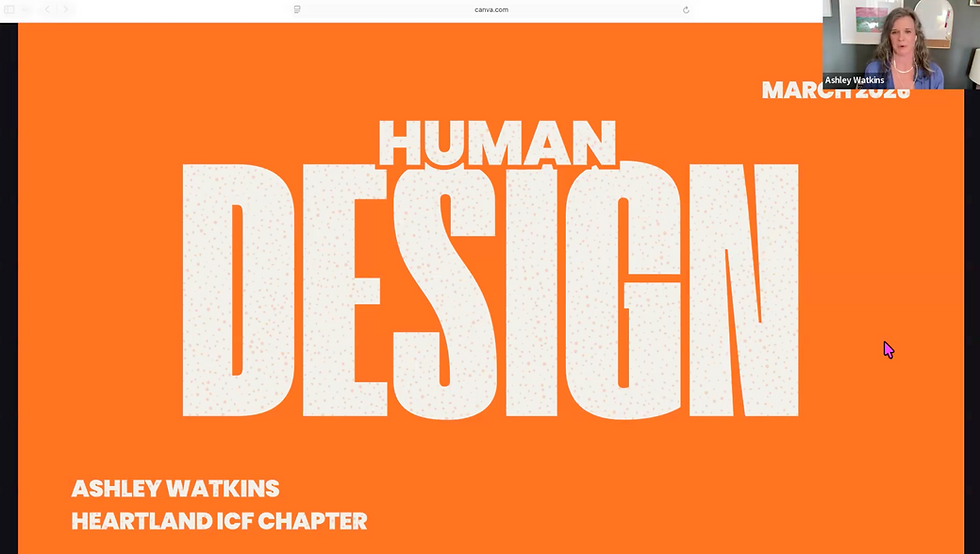
That's the invitation Human Design brings to coaching. Recently, I had the pleasure of presenting an introduction to Human Design for a group of ICF coaches through ICF Heartland — and the conversation that unfolded reminded me of exactly why this framework belongs in the coaching world.
Human Design: Another Self-Awareness Tool (A Good One)
If you've worked with Enneagram, DISC, or Myers-Briggs, you already understand the power of a framework that gives people language for how they're wired. Human Design works similarly — it's a self-awareness tool that draws on astrology, the I Ching, the Kabbalah, the Hindu chakra system, and quantum physics to generate a unique blueprint based on your birth date, time, and place.
What makes it particularly useful in coaching? It gives both coach and client rich, specific language around energy, decision-making, and how we attract aligned opportunities. And you don't necessarily need to run a chart for every client to benefit — understanding the framework can deepen your listening and strengthen the questions you ask.
The Big Three: Type, Strategy, and Authority
Human Design has many layers, but the foundation — and frankly, where the real power lives — is in what I call the Big Three: Type, Strategy, and Authority. I spent years here before going deeper, and I'd recommend the same entry point for coaches who are just getting started.
Type: How We Use Energy
There are five types in Human Design: Generators, Manifesting Generators, Projectors, Manifestors, and Reflectors. About 70% of the population are Generators or Manifesting Generators — they tend to have consistent, powerful energy when engaged in work that lights them up. Projectors are natural guides and advisors; their energy is more precious and ebbs and flows. Manifestors carry initiating energy and can create opportunities from thin air. Reflectors, the rarest type at about 1%, are highly sensitive to their environment and the people around them.
From a coaching standpoint, understanding type opens up powerful questions around energy management, burnout prevention, and what "sustainable" actually looks like for a specific client — because it's genuinely different for each type.
Strategy: How We Attract Aligned Opportunities
Strategy is about how each type identifies and moves toward the right opportunities — and it's worth noting that "waiting" in Human Design is never passive. Generators and Manifesting Generators wait to respond, meaning they let something show up in their world and then check in with their gut. Projectors wait for the invitation — a specific, genuine ask from others before investing their energy. Manifestors initiate but do best when they inform the key people in their lives before acting. Reflectors wait through a full lunar cycle before making big decisions.
For coaches, understanding strategy is a direct support to the ICF competency of helping clients create aligned action. When a client keeps forcing opportunities that don't feel right, or says they feel frustrated and stuck, their strategy — and whether they're following it — is worth exploring.
Authority: How We Make Decisions
Authority is my favorite part of the framework to bring into coaching conversations — and it maps beautifully onto what we already know about trusting clients to find their own answers.
Some people are wired for spontaneous decisions: Trust Your Gut authority (that full-body yes or no) and Tuned Into Your Intuition authority (a quiet, reliable inner voice). Others need time: Wait for Clarity means sleeping on it, Tuning Into Your Willpower is about checking whether you truly have the energy to see something through, and Talk It Out means processing aloud with a trusted person — not for advice, but to hear yourself arrive at clarity. And Reflectors do best with the full lunar cycle.
As coaches, we already hold space for clients to find their own answers. Human Design gives us a more specific lens: your client may not need a better pros-and-cons list. They may need to sleep on it. Or say it out loud. Or wait for the right invitation. Knowing that — and listening for it in session — can completely shift the quality of the coaching.
What This Looks Like in the Room
You don't have to generate a chart for every client to use this framework. Even a general understanding of the types and authorities can help you listen differently. Is your client talking about feeling burned out and bitter? That's a Human Design signal worth noting. Are they forcing opportunities that feel misaligned, or second-guessing gut feelings they already have? That's information too.
And there's one more layer worth naming: your own design affects the coaching relationship. If you're a Generator coaching a Projector, you're bringing different energy into the room. Being aware of that — and not inadvertently projecting your own decision-making style onto your client — is just good coaching practice, made more visible through this lens.
As one way to sum it up: vibes are real. Energy is real. Human Design just gives us language for something we already feel.
A Simple Starting Point
If you're curious to explore your own design, the website I recommend is humandesignblueprint.com — the basic chart is free, and you just need your birth date, time, and place. (Birth time does matter; within 30 minutes is usually close enough to get started.)
And if you want a guided starting point, schedule an introductory session with me. It's a great way to get grounded in your type, strategy, and authority — and to see what opens up when you start living more in alignment with your design.
For your own experiment: pay attention this week to your self-signature and not-self signature. Notice where things feel like flow — and where they feel like friction. That alone can tell you a lot.
Live your design. 💛
—
Have questions about Human Design or how it might show up in your coaching practice? Send them my way at ashleywatkinscoaching@gmail.com — or tune in to the Your Human Design Coach podcast.



Comments